Can Tiny Drones Win the War on Genocidal Maniac Mosquitoes?
 MaximJuly 29, 2026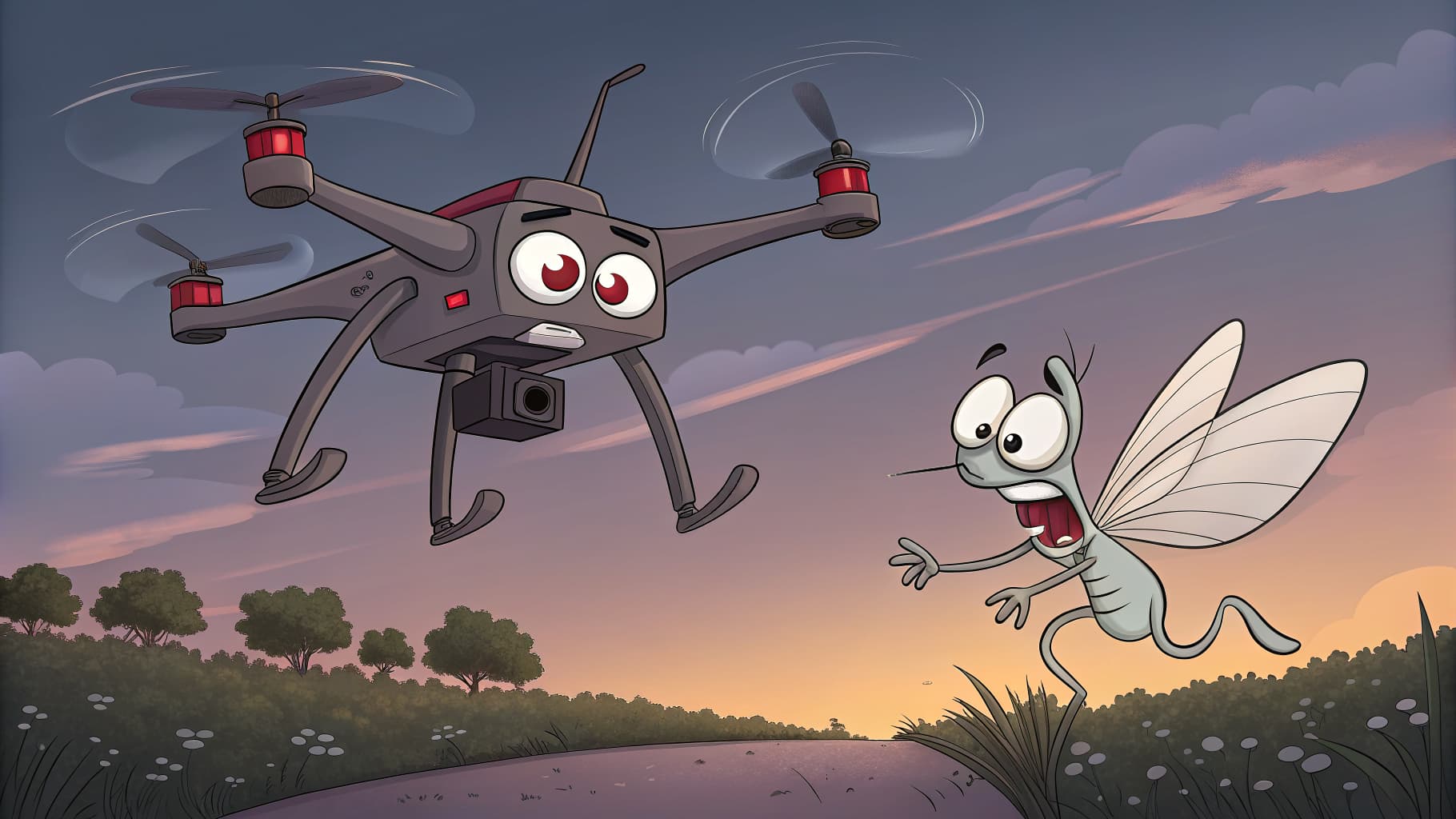
A French startup called Tornyol thinks the answer is yes, and it's building a 40-gram autonomous drone to prove it.
But one has to ask; Can it really do any better than a sweaty, topless and sleep deprived man jumping on a bed and swatting at them with an old smelly sock?
Let's dig in.
How it works
The concept is simple to describe and hard to build. The drone emits ultrasonic pulses and listens for the echo, using lots of teeny, tiny microphones to pick up the Doppler signature of an insect's wingbeats. Every species beats its wings at a slightly different frequency, so the system can, in theory, tell a mosquito apart from a bee or a moth. Once it locks onto a target, it physically rams into the insect mid-air. No chemicals, no spray, no residue.
Maybe it should just be programmed to target the most scary high-pitched frequency imaginable, and seeing as mosquitoes love flying straight into your ears whilst you sleep, just one of these drones on your bedside table should suffice.
Anyway. The hardware is a repurposed 40-gram toy drone, retrofitted with parts borrowed from smartphone microphones and the parking sensors fitted to cars, all run through custom digital signal processing. It's designed to work alongside a base station that patrols a garden or yard around the clock.
Tornyol is backed by Y Combinator (Fall 2025 batch) and earlier raised a 28,630 dollar grant on Manifund, which the founders credit to Scott Alexander's ACX Grants and Vitalik Buterin. The founders, Clovis Piedallu and Alex Toussaint, have framed the long-term goal as driving down the cost of mosquito control by a factor of a hundred, far enough to make a dent in malaria. The World Health Organization puts malaria deaths at 610,000 in 2024, with children under five accounting for about 75% of them in the African Region, which carried around 95% of the global total.
It always bugs me (pun intended) that a single shark attack makes headlines around the world, while the animal that kills more people than any other, ourselves included, barely makes the news.
Where things actually stand
It's worth being precise about the stage this is at. As of mid-2026, the most concrete public demonstration is a test in which a real drone flew freely but was tracked by motion-capture cameras and steered by a computer sitting outside it, rather than running the sonar and control loop onboard, and intercepted a moth in flight. That's a genuine milestone for a hard robotics problem, and it's a long way from a finished consumer product. Independent verification of species-detection accuracy, false-positive rates and safe operation around pollinators in real outdoor conditions doesn't yet exist publicly. The company is currently taking refundable pre-order deposits rather than shipping a finished unit.
The case for it
It could actually reduce disease. Malaria, dengue and Zika are all mosquito-borne, and cheap, scalable interception could complement, though not necessarily replace, bed nets, vaccines and spraying programmes in the regions hit hardest.
No chemicals. Traditional control leans on insecticides and pesticides, which don't stay put. They drift, they accumulate, and they hit species nobody was aiming at. A mechanical kill avoids all of that by design.
Selectivity is the whole pitch. If wingbeat detection genuinely works at scale, it's a far more targeted approach than fogging a neighbourhood, and it could, in theory, leave bees, moths and other pollinators alone.
The case for caution
"Designed to avoid bees" isn't the same as "proven to avoid bees" in the field. Detection accuracy in a lab or a garden trial is one thing. Reliability across the huge diversity of insect species and environmental noise in the real world is another. A drone with an imperfect classifier is still a drone killing insects at scale.
Nobody knows the second-order effects yet. Removing large numbers of any insect from an ecosystem, even a pest, changes the food available to birds, bats, spiders and other predators. Mosquitoes are unpleasant to us, but they're not ecologically inert.
Manufacturing and running fleets of drones isn't free. Batteries, electronics and continuous flight all carry an energy and materials cost. Depending on how the units are powered and how often they need replacing, the net environmental maths isn't obviously better than the alternatives it's trying to beat.
There's a real ethics conversation buried in here. Deliberately building a machine whose job is to kill living things, even insects, at scale and autonomously, raises questions some people will want answered before this turns up in back gardens or public health programmes.
Technology dependence is a legitimate worry. Malaria control has always worked best as a mix of methods: nets, larval source management, habitat modification and community health work. A flashy drone shouldn't crowd out unglamorous interventions that are already proven to work, especially in low-resource settings where the $50 a month subscription, or $1,100 outright, that Tornyol is taking pre-orders for isn't remotely viable.
Worth exploring further
- How would the cost per hectare compare with existing tools such as larvicide treatment or bed net distribution, at real-world accuracy rates rather than lab conditions? Surely providing bed nets to those most at risk would be far cheaper than a $50/month subscription???
- What does regulatory approval look like for an autonomous, kill-capable drone, especially one aimed at public health deployment rather than a private garden?
- Who verifies the species-selectivity claims independently, given that the company's own tests are currently the only public data?
So, better than the sock?
On current evidence the sock is still unbeaten, and that isn't really a criticism. Tornyol has made real progress on a genuinely hard problem in miniature autonomy, which is interesting whether or not it ever ends up on anyone's bedside table. The gap between hitting a moth with the thinking done offboard and clearing a garden unsupervised is exactly the gap that swallows most drone startups, and it's the part worth watching.
References
Co-Founder, Terasor
Documentary and portrait photographer, UK
Maxim is Co-Founder of Terasor and a UK based documentary and portrait photographer. He flies a DJI Mini 4 Pro and writes about UK drone regulations, the wider industry, and the platform from a working photographer's point of view.
LinkedIn