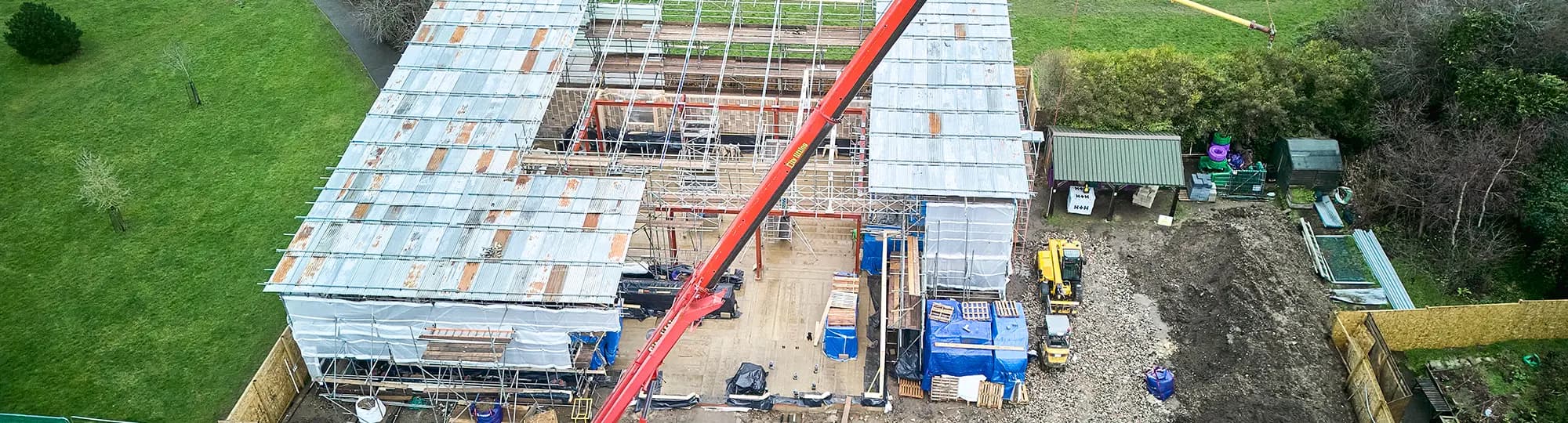
Drone Construction Surveys and Site Monitoring
Repeatable aerial documentation of the whole site, flown to the same pattern on every visit, without a cherry picker or a scaffold survey.
In a hurry? Start from a ready made progress record package
What this service involves
The core of construction drone work is regular progress monitoring: weekly or monthly flights that produce dated records for investor updates and planning authority reports. Alongside that, pilots carry out pre-construction surveys documenting existing conditions, and topographic overviews that show site access, material storage, and progress against the programme.
On completed or partially completed structures, pilots inspect roofs and facades from the air, and thermal-equipped drones show where a roof is losing heat and where a flat roof holds a temperature pattern that often means trapped water, none of which is invisible to a standard camera. Thermal work requires both the right drone and a pilot trained to interpret it, so specify it when you post the charter.
The point of drone monitoring is consistency. Because a pilot can replicate the same flight path and elevation on every visit, the imagery is directly comparable month to month, which makes progress obvious at a glance and gives investors and stakeholders a clear, trustworthy record.
Who hires drone pilots for this, and why
Construction aerial work is bought by the people who need to prove what a site looks like without sending anyone to height:
- Site managers who need an accurate, dated progress record of a site while it is being worked.
- Property developers reporting to investors and lenders on milestones.
- Planning departments requiring documentation of conditions before and after works.
- Scaffolding and roofing companies quoting accurately from elevation before mobilising.
- Architects and surveyors gathering current-condition evidence for reports.
- Health and safety officers assessing hazards from the aerial imagery.
What to expect on the day
Access and safe operating areas are agreed with site management before anything flies. An active site means a pre-flight safety briefing and constant awareness of cranes, plant, and overhead lines, which is why a site visit generates detailed questions before the date rather than on it.
A standard site flight takes around 60 to 90 minutes. Deliverables usually include high-resolution stills from multiple elevations, a short overview video, and GPS-tagged files on request. Recurring work is normally arranged as a schedule rather than as separate visits, because consistency of position and interval is what makes the series comparable. Agreeing the cadence once, at the start, is what keeps the imagery consistent and the process predictable.
A site can also be captured as a 3D scene rather than as stills, turned and looked around in a browser by anyone you send the link to. There are worked examples in 3D World.
Typical costs
Survey, mapping and progress work
Progress visits sit at the lower end, measured survey deliverables at the upper.
| Region | What operators publish | Companies |
|---|---|---|
| United Kingdom | GBP 475 to 1,400 | 7 |
| Mediterranean | EUR 325 to 800 | 10 |
| United States | USD 300 to 925 | 7 |
| Canada | CAD 200 to 575 | 7 |
Below our evidence threshold, so stated as observations rather than ranges: Australia at AUD 150 to 2,300, from 4 companies.
The unit changes with the border. French and Italian operators price the flight and the data processing as two separate line items, American firms sell monthly programmes with a minimum visit count, and one Canadian operator prices maps per square metre by resolution. A single figure flattens all of that.
Quoted per project rather than priced openly: recurring monthly monitoring and liDAR and volumetric work at scale.
The better the operator, the less likely they publish. Every dedicated LiDAR and legal survey firm found in Canada, and every certificated survey operator found in New Zealand, publishes no price at all.
Where these figures come from. They are measured from prices that drone companies publish on their own websites, read in August 2026. They are not quotes and they are not averages. Each range covers the middle of what publishers in that region charge for that job, the number of companies behind it is shown beside it, and nothing is converted between currencies.
What moves the price. Post production is the largest single factor, and most operators charge for the edit separately from the flying. What you are handed at the end matters next: imagery on its own, an edited film, and a written report are three different products. After that come time on site, travel, and any permission the location needs. Only about one company in five states whether its published price includes tax, so published figures are not always comparable with each other.
One thing worth knowing. The better the operator, the less likely they publish a price at all. The heavy lift and cinema companies, the dedicated survey and LiDAR firms, and the most heavily certificated operators in every region we measured publish nothing. These figures describe the part of each market that does publish.
Ongoing work suits repeat bookings, since a pilot who already knows your site needs less briefing on each return visit. The pilot is paid when each set of deliverables is approved.
Frequently asked questions
Can drones fly over active construction sites?
Yes, with the right preparation. The site is private land, so access and safe operating areas have to be authorised by the principal contractor or site manager. Flights are planned around cranes, plant, and overhead lines, and most sites require a short pre-flight safety briefing. Those are the site's requirements rather than optional extras, so it is fair to ask how they will be met.
What qualifications does a construction site drone pilot need?
In the UK, an Operator ID and Flyer ID at minimum, plus an Operational Authorisation or GVC for work near people and structures, which describes almost every active site. Site clients often also expect public liability insurance and sometimes a CSCS card or site induction. Terasor does not hold or verify pilots' documents. A profile shows what a pilot has chosen to state about their own licences, insurance and permissions; nothing there has been checked by us, and not every pilot fills it in. Ask to see the certificates before you book, and ask for the ones covering the specific work you want done, because a permission that covers one kind of flight often does not cover another.
How do I get GPS-tagged or georeferenced imagery?
Note it in your charter brief. Many pilots can deliver GPS-tagged stills as standard, and pilots equipped for survey work can provide georeferenced imagery and orthomosaics suitable for measurement. If you need survey-grade accuracy, ask for a pilot with RTK GPS capability and state the deliverable format you need.
Can drone footage be used for planning applications?
Yes. Dated, high-resolution aerial imagery is widely used to document existing site conditions and to evidence progress for planning departments and stakeholders. If the imagery needs to support measurements or a specific report format, say so in the brief so the pilot can plan the flight and deliverables accordingly.
How quickly can a pilot be on site?
For a site in open airspace, within a few days and often sooner. The variables are site access coordination and any airspace clearance if the site sits near an airport or restricted zone. For recurring monitoring, most clients brief a preferred pilot once and then lock in a fixed monthly slot, which removes the lead time entirely.
Which certificates, and what each one covers: What we check, and what you should.