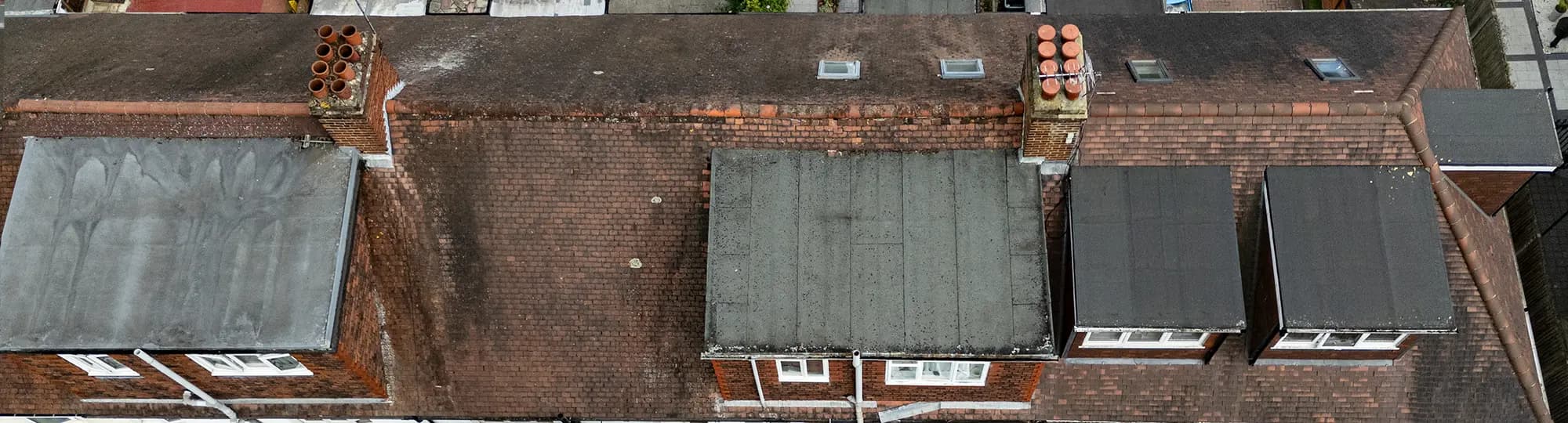
Drone Roof and Building Inspections
Inspect roofs, gutters, facades, and chimneys in close-up detail without scaffolding, ladders, or putting anyone at height.
In a hurry? Start from a ready made site observation package
What this service involves
A drone captures close-up 4K footage and stills of guttering, ridge tiles, chimney stacks, flat roof membranes, flashing, solar panels, and facade cladding without scaffolding, a cherry picker, or anyone working at height. It does not need access equipment, and it leaves a record rather than an account: dated images of every elevation, which you can look at before agreeing any work.
For heritage and listed buildings, where scaffolding is impractical, restricted, or expensive, a drone inspection is one non-invasive way to see the whole roof, alongside rope access, elevated platforms and pole cameras. Thermal equipped drones go further, showing where a roof is losing heat and where a flat roof holds a temperature pattern that often means trapped water. The camera reads temperature rather than moisture, so confirming what a pattern means is a judgement for somebody trained to make it.
The usual deliverables are high-resolution stills from multiple elevations plus a short video walkthrough, which you can pass straight to a contractor for a quote, to an insurer as evidence, or to a surveyor to support a report. Most residential roofs are covered in a single visit.
Who hires drone pilots for this, and why
Anyone who needs to know the condition of a roof or facade without putting anyone on it:
- Homeowners checking for storm damage, slipped tiles, or blocked gutters.
- Landlords documenting condition before and after a tenancy.
- Property managers maintaining commercial and multi-unit buildings.
- Building surveyors adding aerial evidence to their reports.
- Insurers requiring condition evidence before or after a claim.
- Architects recording existing conditions ahead of a renovation.
What to expect on the day
The pilot needs a clear takeoff and landing point near the property, usually a garden, driveway, or adjacent open space. Most residential inspections take around 30 to 60 minutes including setup and an on-site review of the footage to make sure the areas you care about are well covered.
Agree the delivery format and turnaround when you book. If you need an annotated report highlighting specific areas of concern, many pilots offer this as an add-on, so mention it in the charter notes when you post the job.
A building can also be captured as a 3D scene, which is flown as slow orbits rather than as an inspection pass and opens in a browser rather than playing as video. There are worked examples in 3D World.
Typical costs
A roof or building inspection
Imagery of the roof, elevations and gutters. A written report is usually charged separately.
| Region | What operators publish | Companies |
|---|---|---|
| United Kingdom | GBP 150 to 500 | 16 |
| Mediterranean | EUR 225 to 475 | 10 |
| United States | USD 225 to 625 | 9 |
Below our evidence threshold, so stated as observations rather than ranges: Canada at CAD 250 to 875, from 3 companies, Australia at AUD 275 to 2,250, from 4 companies and New Zealand at NZD 100 to 250, from 3 companies.
The New Zealand figures are a different product rather than a cheaper market: there the drone survey is sold as an add-on to a builder or pre-purchase report, not as a standalone inspection.
Quoted per project rather than priced openly: thermal imaging, which needs different equipment and a pilot trained to read it.
A written report is usually charged separately from the flight, and the cheapest published figures buy imagery only. No company found anywhere publishes a price for a chartered surveyor report.
Where these figures come from. They are measured from prices that drone companies publish on their own websites, read in August 2026. They are not quotes and they are not averages. Each range covers the middle of what publishers in that region charge for that job, the number of companies behind it is shown beside it, and nothing is converted between currencies.
What moves the price. Post production is the largest single factor, and most operators charge for the edit separately from the flying. What you are handed at the end matters next: imagery on its own, an edited film, and a written report are three different products. After that come time on site, travel, and any permission the location needs. Only about one company in five states whether its published price includes tax, so published figures are not always comparable with each other.
One thing worth knowing. The better the operator, the less likely they publish a price at all. The heavy lift and cinema companies, the dedicated survey and LiDAR firms, and the most heavily certificated operators in every region we measured publish nothing. These figures describe the part of each market that does publish.
The pilot is paid only after the footage is delivered and approved.
Frequently asked questions
Is drone roof inspection as accurate as a physical survey?
For visual condition assessment, a 4K drone close-up records the whole roof from above, every pitch and elevation. It does not replace a hands-on structural survey where physical testing is needed, but for spotting damaged tiles, blocked gutters, failed flashing, or membrane faults, aerial imagery is detailed, and captured without anyone going onto the roof.
Can drone footage be used as evidence for an insurance claim?
Dated, high-resolution aerial imagery is a clear record of what a roof looked like on a given date, which is the thing a claim usually turns on. How much weight any given insurer gives it is a question for them rather than for the pilot, so ask yours what they will accept before you commission the work. If your insurer needs a specific format or an annotated report, note that in your charter brief so the pilot can deliver exactly what the claim requires.
What if the roof is in a restricted airspace zone?
The airspace at your address decides this, so check it before you book: whether the building sits inside a Flight Restriction Zone or a restricted area, and if it does, who has to give permission. Many restricted areas can still be flown with the right authorisation or coordination, it just needs planning. Share the full address when you post the charter so pilots can factor any clearance into their bid and timeline.
Do I need to notify my neighbours before a drone inspection?
Rules on overflight and on privacy differ by country, so what applies at your address is worth asking about directly. Whatever the position, a courtesy heads-up is good practice, especially in terraced or densely packed housing where the drone may briefly pass near a boundary. Those rules and your boundary line are what keep the flight over your own property, and a quick word with neighbours avoids any surprise.
How do I get an annotated inspection report?
Ask for it in your charter brief. Many pilots offer an annotated report as an add-on, marking specific areas of concern on the stills so you can share them directly with a contractor, insurer, or surveyor. Confirm the deliverable and format with the pilot before you accept the bid so the price reflects the extra work.
Find drone pilots for roof and building inspections in:
Drone roof inspections by area:
Fly drones for work in any of these places, or anywhere else? Terasor is looking for pilots. See what a pilot account includes.